
The problem
Preslar's is a Louisville institution. Real inventory, real staff, a healthy in-store business, and a name people around here already know.
The online side had quietly stopped working. Thousands of products carried thin titles and missing descriptions, so Google had almost nothing to read. Worse, an account-level policy flag had put the entire catalog into a limited state in Google Merchant Center. The whole store was effectively switched off in Google Shopping, and it had been that way long enough that nobody remembered it being any different.
That's the pattern most local retailers hit eventually. The storefront is fine. The online side belongs to nobody.
What I did, in order
- First, audit everything Before touching anything I mapped the whole stack: the ecommerce platform, the product data, the Google Ads account, the Merchant Center feed, and the tracking. The point was to know what was safely fixable, what needed the platform vendor, and what order to do it in.
- Rebuild the product data, in batches Rewrote titles, descriptions, and category structure across thousands of products. Every batch got verified against the store's own back office before I called it done. Nothing was marked complete on faith.
- Clear the Merchant Center flag Fixed the policy problems behind the account-level flag and got the business verified with Google. In June the flag cleared and the catalog came back into Google Shopping.
- Let the free listings work With the catalog eligible again, free Google Shopping listings started earning clicks for the first time. That's shelf space on Google the store had never occupied, at no ad cost.
- Measure it properly I split the rebuilt products into two groups by the date each one was pushed, then compared each group against the other. If the lift were just spring demand or the site redesign, both groups would move together. They didn't. Each group only jumped after its own push.
- Move the store to Shopify Moved the point of sale and the website to Shopify. The registers went live on 31 August 2026 and the new website on 8 September.
The result
Every Search Console chart here compares the same two 28-day windows, 24 March to 20 April and 3 to 30 August 2026. The free-listing clicks come from Merchant Center.
Then a record month
August 2026 set the store's record for online orders: 16. July was close behind at 15, more than May and June put together. From January to September, online sales rose 196% over the same months of 2025, measured on merchandise before tax and shipping. That already makes 2026 the store's best online year since its records began in 2019. The numbers come from the store's own order records. They leave out gift cards, test orders and cancelled orders.
Where these numbers come from. The search figures come from the store's own Google Search Console, the free-listing clicks from Google Merchant Center, and the sales numbers from its own order history. Search Console data for this store starts 24 March 2026, so the growth figures compare two equal 28-day windows inside that period, not a full year. Every number here comes straight from those accounts, not a projection.
Why this worked
None of it was one dramatic move. It was sequence and follow-through.
Audit first. Fix the product data. Clear the thing blocking the whole catalog. Then let free listings do their job on top of clean data, and check every step against real numbers instead of assuming it landed.
That's the part a local business usually can't get without hiring a full-time digital person. Not a redesign. Somebody who actually owns the online side week after week.

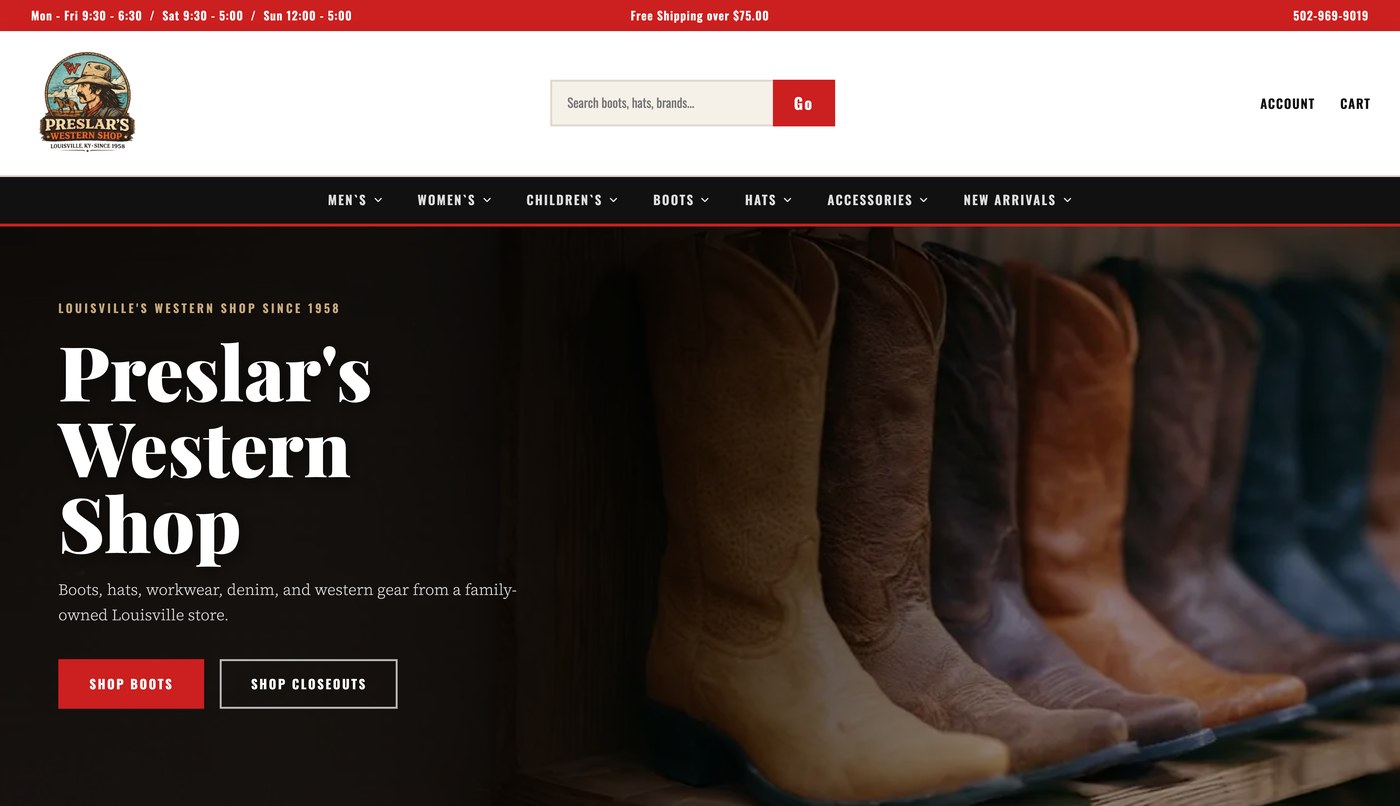
Go see the store for yourself.
Boots, hats, workwear, and denim from a family-owned Louisville shop that's been at it since 1958.
The pattern this fits
This is the local retail and ecommerce cleanup pattern. It works the same way for boutiques, specialty retailers, and inventory-heavy local stores on older platforms. Anywhere the products, the ads, or the tracking have nobody really owning them.
If the catalog side isn't your problem and you just need to be found, that's the smaller version of the same work. It lives on the Louisville SEO company page.
If the storefront is solid but the online side feels messy, this is what fixing it looks like.
