The Starting Point: A Business With a Reputation Problem
The client: A home services company based in Louisville. They'd been at it for over a decade. Strong reputation locally. Lots of referrals. Good reviews. The usual stuff that keeps a business healthy.
The problem: They expanded to twelve new markets across Kentucky, Indiana, and Ohio. They figured their reputation would follow them. It didn't.
In Louisville, they showed up on page one for their main services. In every new market? Invisible. Page 5, page 6, or not showing up at all.
"We'd been in business for 15 years, but when someone searched for our service in Lexington, it was like we didn't exist. All that history meant nothing in a new city."
Initial Rankings Across New Markets
| Market | Primary Keyword | Starting Position |
|---|---|---|
| Lexington, KY | [service] lexington ky | #47 |
| Bowling Green, KY | [service] bowling green | #52 |
| Owensboro, KY | [service] owensboro | Not ranking |
| Elizabethtown, KY | [service] elizabethtown | #63 |
| Cincinnati, OH | [service] cincinnati | Not ranking |
| Indianapolis, IN | [service] indianapolis | Not ranking |
The real issue: Their website had one page that said "we serve these areas" with a list of cities. That's what almost every business does. And that's exactly why almost every business fails at multi-location SEO.
Why "Adding a Locations Page" Doesn't Work
Let me break down what Google actually needs to see before it believes you serve a market:
Relevance. Does your content actually talk about that location? Not a bullet point in a list. Real content.
Authority. Do other websites mention you in that market? Directories, citations, local links.
Prominence. Is there any proof you actually operate there? Reviews, local content, a real business presence.
A page that says "I serve Louisville, Lexington, Bowling Green, Owensboro, Elizabethtown, and 30 other cities" tells Google nothing. It looks like spam. You're claiming to be everywhere but proving you're nowhere.
Every market you want to rank in needs its own page, its own proof, and its own work.
The Strategy: Treat Every Market Like a New Business Launch
I approached each new market the same way you'd approach launching a brand new business. Because in Google's eyes, that's exactly what this was.
Four pillars:
- Dedicated location pages: Real pages with real content for each market
- Google Business Profile optimization: Separate listings, fully built out
- Local citation building: Directory presence in each market
- Supporting content: Blog posts and resources targeting each area
Here's how I handled each one.
Pillar 1: Location Pages That Actually Rank
Most location pages are garbage. They're the same template with the city name swapped out. Google sees right through it.
What I built instead:
Unique Content for Each City
Every location page got genuinely unique content. Not just the city name replaced. Real differences:
- Specific neighborhoods and areas served within that city
- Local landmarks and reference points (people search "near [landmark]")
- Mention of local challenges (climate issues, common property types, local regulations)
- City-specific testimonials when available
- Different featured projects or examples for each market
Proper Technical Structure
Each location page had:
- Title tag: [Service] in [City], [State] | [Company Name]
- H1: [Service] Services in [City], not generic, specific to the service and place
- Schema markup: LocalBusiness schema with the specific location data
- Embedded Google Map: Showing the service area for that specific location
- NAP consistency: Name, address, phone exactly matching the Google Business Profile
Critical: Each page was at least 800-1,200 words of unique content. Not thin pages. Not doorway pages. Real, useful content that someone in that market would actually read.
Pillar 2: Google Business Profile Domination
For service-area businesses, your Google Business Profile is often more important than your actual website for local rankings. You can show up in the map pack even if your website ranks lower in the regular results.
One Profile Per Service Area
I created (or claimed existing) Google Business Profiles for each market. For a service-area business, you don't need a physical office in each city. You just set your service areas.
What I optimized on each profile:
- Business name: Consistent with NAP. Don't stuff keywords here
- Categories: Primary category set to the most relevant service
- Service areas: Set precisely, typically a 25-30 mile radius
- Business description: Unique for each location, mentioning specific markets
- Photos: At minimum, 10+ photos per listing, geotagged when possible
- Posts: Weekly posts on each profile with updates, tips, promotions
- Q&A: Proactively added common questions and answers
Review Strategy
Reviews are a huge ranking factor. I made sure every customer in the new markets got asked for a review, every review got a response within 24 hours, and the focus was on building up review volume fast in those new areas.
Within six months, each new market location had 15-30 reviews with an average rating above 4.7.
Pillar 3: Local Citation Building
Citations are just mentions of your business on other websites. They're how Google confirms you actually exist in a market. It's boring work, but it matters.
Tier 1: Major Directories
Every location got listed on Yelp, Yellow Pages, BBB, Angi, HomeAdvisor, Manta, MapQuest, Apple Maps, Bing Places. The big ones.
Tier 2: Local Directories
Each market has its own local directories too. Chamber of commerce listings, state business directories, local newspaper directories, Nextdoor verification.
NAP consistency is critical. Name, address, phone have to be exactly the same on every single listing. If it's different anywhere, Google gets confused.
Pillar 4: Supporting Content
Location pages alone aren't enough. I built supporting content targeting each area:
- "[City] [Service] Guide: What Homeowners Need to Know"
- "Common [Problem] Issues in [City] and How to Fix Them"
- "How to Choose a [Service Provider] in [City]"
- "[Season] [Service] Tips for [City] Homeowners"
These posts linked back to the main location page, building internal link equity.
The Results: What Actually Happened
Traffic Increase
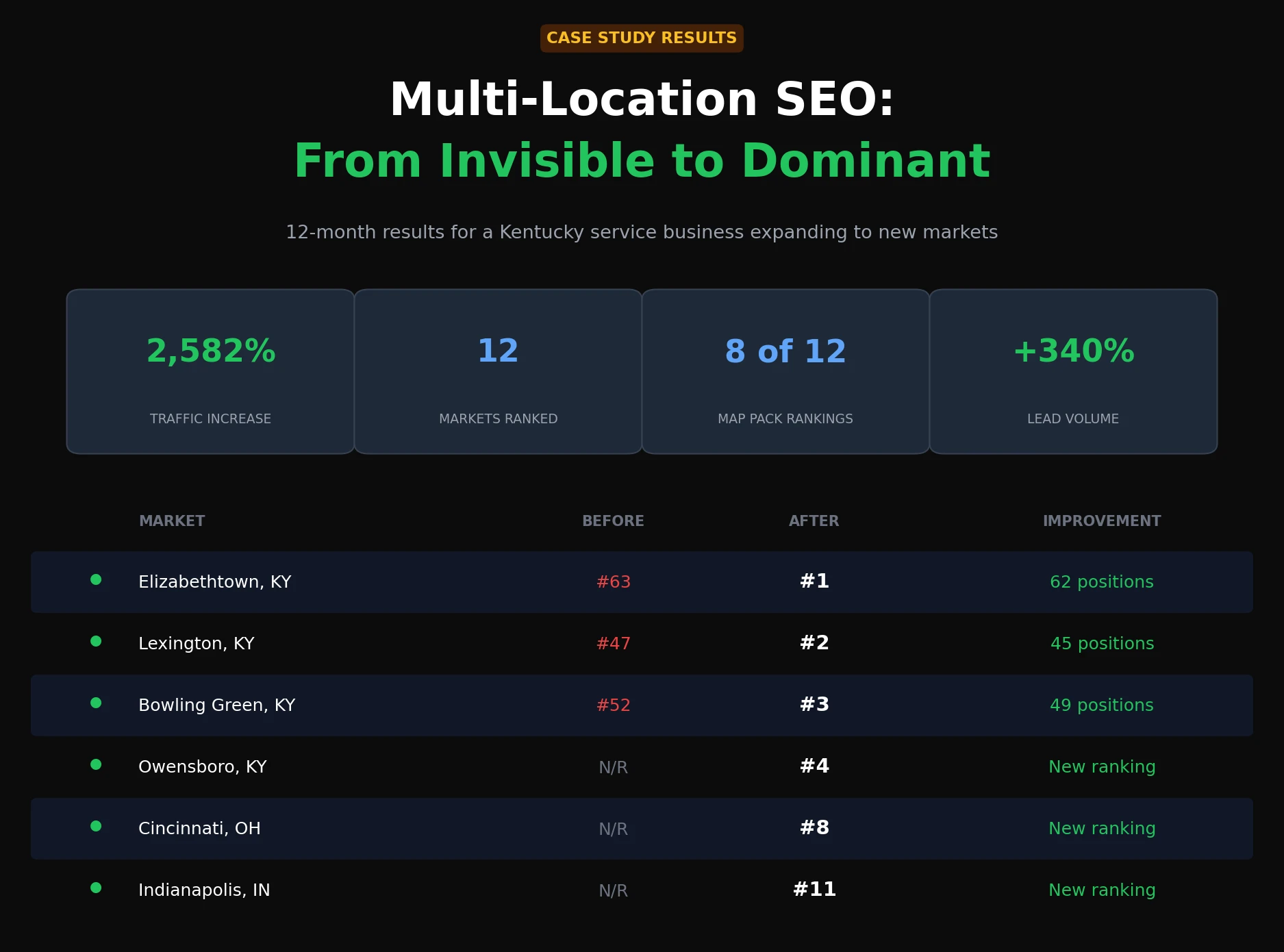
Before I started, the website got almost no organic traffic from the new markets. After twelve months, organic sessions from those markets made up 34% of total website traffic.
Ranking Improvements
| Market | Primary Keyword | Before | After | Improvement |
|---|---|---|---|---|
| Lexington, KY | [service] lexington ky | #47 | #2 | +45 positions |
| Bowling Green, KY | [service] bowling green | #52 | #3 | +49 positions |
| Owensboro, KY | [service] owensboro | Not ranking | #4 | Not ranking → #4 |
| Elizabethtown, KY | [service] elizabethtown | #63 | #1 | +62 positions |
| Cincinnati, OH | [service] cincinnati | Not ranking | #8 | Not ranking → #8 |
| Indianapolis, IN | [service] indianapolis | Not ranking | #11 | Not ranking → #11 |
And it wasn't just the main keywords. All the variations, long-tail searches, and "near me" terms came along for the ride. Many markets went from zero keyword rankings to 50+ keywords in the top 20.
Map Pack Performance
8 of 12 markets ranking in the Google Map Pack (top 3 local results)
This is where the real leads come from. People click on map pack results way more than regular search results because they can see your rating, read your reviews, and call you right from the listing.
Business Impact
- Lead volume from new markets: +340% compared to baseline (pre-SEO expansion)
- Cost per lead: decreased 62% compared to paid advertising in those markets
- Revenue from new markets: grew from 8% to 31% of total company revenue
Once the organic rankings kicked in, the client started pulling back on paid ads in those markets. Less money going to Google, more money staying in their pocket.
What You Can Take From This
Whether you're expanding to two new cities or twenty, the playbook is the same:
Do This:
- Create dedicated, substantial pages for each market. No thin content. No copy-paste with city names swapped. Real pages with real value.
- Set up Google Business Profiles properly. One per service area. Categories dialed in. Photos added. Posts scheduled.
- Build consistent citations across directories. NAP must be identical everywhere. Start with major directories, then add local ones.
- Generate reviews in each market. Ask customers. Make it easy. Respond to every review.
- Create supporting content. Blog posts, case studies, neighborhood pages. Show Google you have depth.
- Be patient. Multi-location SEO takes 6-12 months to fully compound. Quick wins happen, but real dominance takes time.
Don't Do This:
- Don't create doorway pages. Thin, duplicate pages designed just to rank will get you penalized.
- Don't stuff keywords. Write for humans first. Optimization should be invisible to readers.
- Don't ignore your GBP. For local searches, your Google Business Profile matters as much as your website.
- Don't expect your existing reputation to transfer. Every new market is a fresh start.
- Don't skip citations. They're boring, but they work.
Is Multi-Location SEO Right for Your Business?
This kind of work is a great fit for:
- Service businesses expanding to new cities
- Franchises wanting consistent local visibility
- Multi-unit retailers (restaurants, salons, clinics)
- Companies targeting specific neighborhoods within a metro area
I'll be honest, it takes real investment. Time and money. Building out twelve location presences isn't cheap. But the other option is paying for ads forever in every single market, and that cost never goes down.
Organic rankings, once you've got them, compound over time. The leads get cheaper. Your presence gets stronger. And your competitors have to outwork you just to catch up.
Key Takeaway
Multi-location SEO takes real local content, not template pages with the city name swapped out. Google can tell the difference. When you invest in genuinely location-specific pages with real reviews, proper citations, and supporting content, you build organic visibility that compounds over time. The leads get cheaper. Your presence gets stronger. And your competitors have to work twice as hard just to catch up. That's the kind of position I want to put you in.